

When the client approached us in 2022, they outlined that whilst the team had significant pharmaceutical launch experience, their knowledge of UK market access for medical devices was much more limited. It’s not an uncommon situation, driven by the complexities and opaqueness of the UK MedTech environment, and the black box that is the NHS. Whilst the device had been launched in the US, the aim was to now plan for launch in Europe. The client was therefore looking for a partner who could provide the additional market access expertise to support them in their preparations for a UK launch, and effectively communicate the value of the device in a priority area for the NHS. Beyond this, the client was looking for a partnership, in which learnings could be discussed regularly and we could share our learnings and advice at key phases to inform the strategy for launch.
This support comprised two streams:
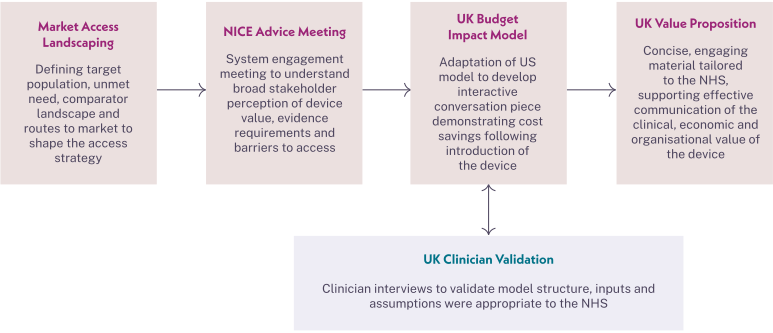
Successful launch of a new medical device requires a detailed understanding of the market you’re trying to enter, including:
We conducted desk research to define the market landscape for this device, bringing our findings together into a coherent “one-stop” landscape deck that provided the UK team with extensive local information on the disease area and our recommendations for launching. This laid the groundwork for all future activities, providing the client with the foundational information required to inform their strategy and next steps.
The landscaping was supplemented with stakeholder engagement, via a NICE Advice system engagement meeting. The meeting brought together NHS clinicians with stakeholders from NICE and the NHS as part of a three-hour meeting to discuss considerations for market access of the device, centred on a list of objectives and topics designed by the client company. As part of our support, we provided strategic input on the overall objectives of the meeting and the briefing document, informed by learnings from the landscaping component, to ensure the client got the most from the meeting. We then joined the meeting and developed a comprehensive report that summarised discussions and synthesised the key findings with implications for the launch strategy. The report then also served as an important mechanism for dissemination to Global colleagues within the client organisation, ensuring alignment on key actions.
Effective communication of the clinical, economic and organisational value of MedTech solutions is essential, and materials must resonate with local stakeholders. Ensuring that materials tailored to the UK were available to support conversations centred on the value of the device was an important part of preparations for launch. Clinical effectiveness data needs to have relevance to the UK population. Economic models must reflect local pathways, and provide an output in pounds and pence.
The client had a global value dossier (GVD), but nothing specific to the UK. The value dossier was a good repository of information around an overarching narrative, but there was a clear need for a more concise material to support discussions with UK stakeholders. We therefore developed a value proposition, leveraging the GVD, but tailored to the UK with evidence sourced via pragmatic literature searches. The burden and unmet need section drew on UK data where possible, including epidemiology, whilst the patient pathway reflected NICE and medical society guidelines that clinicians had highlighted as the basis for UK clinical practice. We developed concise and impactful value messages to support communication of the clinical effectiveness data that resonated against the unmet need, whilst the economic value section was based upon a UK budget impact model to highlight potential cost savings and reductions in healthcare resource utilisation. The clinical and economic value sections were also contextualised with NHS policy information, clearly demonstrating the importance of the device in addressing system priorities.
The budget impact model developed was based on an available US model, adapted to reflect the UK patient pathway and draw on data reflective of UK clinical practice. It was designed to be a standalone conversation piece to support discussions with stakeholders, as well as inform the development of the economic value section of the value proposition. The model was designed with an interactive interface, enabling local client teams to take it to stakeholders within a hospital and use it as a conversation piece. Together they can adjust inputs to reflect their own hospital, with local hospital data for the number of patients pre-loaded into the model to streamline this process. A user guide was developed to help local teams navigate the model, whilst the results of the model could also be exported as part of a brief summary document as a leave-behind piece. To ensure that the model reflected UK clinical practice, interviews with key opinion leaders were conducted to validate the structure of the model, the positioning of the intervention and each of the inputs.
These projects have been essential in preparing the client for launch in the UK in 2025. Market access landscaping helped build the strategy itself. It laid the groundwork for a broad stakeholder engagement strategy, which has ultimately shaped the client’s approach to launch and helped define the positioning for the medical device in the UK. Given the client team’s limited MedTech UK experience, and the ever-changing landscape within the UK, the definition of relevant market access pathways was essential in determining possible routes to market, whilst also providing an enduring resource for internal stakeholders to refer to in future. Utilising NICE Advice has ensured that the strategy has been shaped by relevant UK stakeholders and appropriate to the market, whilst providing initial input on potential pitfalls and areas to address. The value proposition and budget impact model have given the client effective tools to support value-based conversations that will resonate with stakeholders. This work has also served to highlight evidence gaps, with clinician perspectives helping to shape future evidence generation activities. Our knowledge of UK market access has underpinned all components, and we have continuously provided opinion and insights to help shape the work as part of an open, collaborative relationship with the client.
We have a dedicated MedTech team that work seamlessly across our Value and Access, Evidence Development and Medical Communications services to deliver high-quality, scientifically robust support to the MedTech industry. To find out more about our services, or to discuss a future collaboration, please get in touch.
Looking for something specific? Search our case studies here.
