
With indirect treatment comparison (ITC) methods continuing to advance, we were pleased to contribute to a recurring topic at ISPOR Europe 2025, centred around how best to navigate available methods, and select the most suitable. We see the management of the expanding toolkit of ITC methods as key to support Health Technology Assessment (HTA) submissions, including Joint Clinical Assessment (JCA). Our separate commentary on JCA at ISPOR Europe 2025 more widely is available.
Standard ITC methods carry well-known limitations, such as difficulties in handling between-study heterogeneity and the strong assumptions required when considering single-arm trials and disconnected networks. These issues are often highlighted by HTA bodies and can hinder reimbursement. In response, newer approaches like multi-level network meta-regression (now extended to time-to-event outcomes) and ongoing work in population-adjustment methods have expanded the toolkit available for these challenging scenarios.
An issue panel on Tuesday morning at ISPOR Europe 2025 highlighted the spectrum of available ITC methods.1 Dr. Hugo Pedder presented a pragmatic flow diagram designed to guide ITC method selection based on data availability, characteristics of available data and decision context. There was a specific focus here on population-adjustment methods and also discussed the implications of population-adjustment on the generalisability of ITC estimates to the target population. For time-to-event outcomes, there are further considerations too on testing the proportional hazards assumption and considering which methods to use when it fails. While guidelines from European HTA bodies now offer more directives on deploying these methods, acceptability remains variable (see below). This variability complicates both method selection and the formulation of structured guidance on the topic.
The initiation of JCA this year presents a further challenge for ITC method selection. In principle, no ITC method is ruled out by JCA guidelines. However, given the potentially large number of PICOs that need to be addressed with ITCs, various methods may need to be explored in order to “cover all bases”, which may become infeasible, particularly if planning for ITCs is initiated near to the point of JCA.
We see two important ways forward emerging:
We were pleased to contribute our research into differences in methods guidance across Europe in a poster comparing JCA ITC guidelines with NICE guidelines and those from key EU member states.2 While most guidelines aligned in methodology, some nations were more conservative in their acceptance of newer population-adjustment methodology.
However, many of the more conservative guidelines had not been updated for several years, and we would be keen to see development in these guidelines in the coming years to permit the presentation of results from these methods with appropriate reporting requirements. There is also opportunity for harmonisation in guidelines with JCA; acceptance of ITC methods at the JCA level (regardless of the assessor) will be of great interest. As raised in Tuesday’s session, harmonised standards have potential both to ensure consistency and also promote innovation in these focus areas.1
While awaiting development in this space, we see early ITC planning (for example, initiating planning well before the typical 6–12 months prior to HTA submissions) as the key way to get ahead of anticipated challenges.
We were delighted to present our research into how planning as early as the pre-pivotal trial initiation stage can strengthen the robustness of ITCs for JCA.3 Our structured roadmap highlighted the key preliminary assessments that manufacturers can conduct:
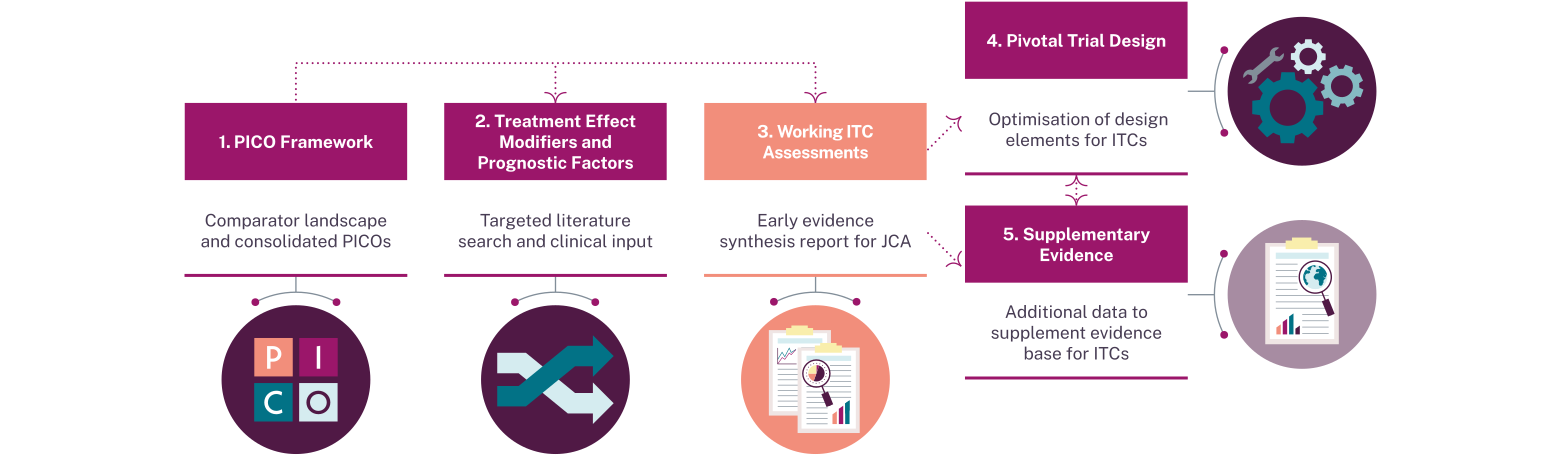
Early ITC planning could involve very comprehensive comparator landscaping and preliminary ITC assessments, but this is not a necessity and every little helps; valuable insights can be gained from even pragmatic approaches to addressing these preliminary assessments at an early stage.
Looking beyond JCA, the steps to selecting the optimal ITC method in the current HTA landscape require considerations beyond what guidelines across Europe are currently offering. Proactive planning with the wide ITC toolkit at hand will be essential, with harmonised guidelines perhaps taking shape to support this in the near future.
References
If you would like any further information on the summary presented above, please get in touch, or visit our Evidence Development or Joint Clinical Assessment pages. Andrei Karlsson (Senior Statistician) and Laura Clark (Senior Statistician) contributed to this article on behalf of Costello Medical. The views/opinions expressed are their own and do not necessarily reflect those of Costello Medical’s clients/affiliated partners.
