
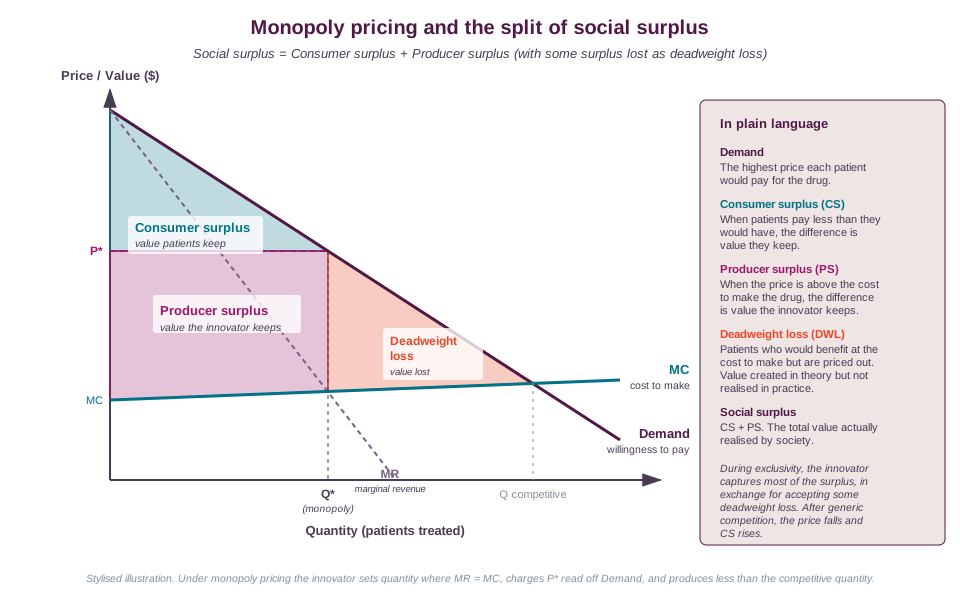
At ISPOR 2026, the MFN drug pricing agenda and pharmaceutical innovation surfaced as interconnected issues. An issue panel on dynamic efficiency (whether a market generates the right level of innovation over time, balancing today’s rewards to innovators against the future value of new products) highlighted a question that the health economics literature has examined but that rarely shapes pricing policy: how much social surplus from a pharmaceutical innovation should accrue to the innovator to maintain the pipeline (Figure 1)?1
Dynamic efficiency is typically achieved when innovators capture close to the full social surplus during exclusivity, particularly with consumer surplus accruing heavily after exclusivity ends (i.e., generic competition). In a global setting, when a large country pays the full surplus share, a small country can deviate downward and “free-ride” on those payments, which sustain global R&D.1 This works because it does not disrupt the innovation engine, the dynamic MFN is designed to address.
Paired with tariffs and trade negotiations, MFN is framed as a trade policy reallocating who funds global R&D, pressuring peer countries to pay more rather than only extracting concessions from manufacturers. A Centers for Medicare & Medicaid Services (CMS) perspective reinforced this framing in a separate session, emphasising cross-country alignment over lower US prices.2
The open question is whether those countries will raise reimbursement to preserve access, or yield to domestic political pressure and accept reduced launches. Peer countries have spent decades building HTA bodies, reference-pricing rules, and budget caps to hold prices down; unwinding that infrastructure would be a heavy political lift. Manufacturers have an incentive to delay or forgo launches in low-priced reference markets to avoid having those prices imported back into the US. Such strategic withdrawal would reduce patient access abroad without raising foreign prices, undercutting the upward-convergence MFN purports to achieve.
First, broad convergence downward threatens innovation: if MFN pulls US prices toward peer levels rather than lifting peers upward, the revenue base that sustains R&D erodes. Second, MFN compares prices without interrogating why they differ. Panellists emphasised that even when innovators capture the full surplus, prices should not be uniform because willingness to pay varies with income, budget constraints, and opportunity cost.1 A lower price in a peer country may reflect genuinely lower willingness to pay rather than free-riding; forcing convergence upward either suppresses access or transfers surplus from patients to innovators without economic rationale. Both concerns argue for the same solution: pricing to country-specific value, not a uniform benchmark.
References
If you would like any further information on the summary presented above, please get in touch, or visit our Health Economics or Market Access pages to learn how our expertise can benefit you. Connor Davies (Consultant) created this article on behalf of Costello Medical. The views/opinions expressed are their own and do not necessarily reflect those of Costello Medical’s clients or affiliated partners
