
As anticipated, the EU Joint Clinical Assessment (JCA) was again a key theme at this year’s ISPOR Europe. The agenda was full of issue panels and presentations promising to provide practical recommendations or to ‘demystify’ the process. However, only eleven-months since the formal launch of JCA, it is still very early days and is clear that it will be many years (or even decades) before we can see the true impact or value of JCA.
Initial excitement and hysteria regarding JCA has given way to focused preparation. Relative to the past two years, there has been a notable reduction in ‘urgency’ and ‘worry’. Many session leads were upfront in saying that industry need to essentially ‘get on with it’, and the repeated message was that it is still too early for any sort of value judgement to be made on whether the implementation of JCA will represent a positive step-change.
The publication of initial JCA reports anticipated early next year (2026) may provide some clarity, for example with regards to industry approaches to addressing PICO requests and how assessors respond. However, several session leads also warned that it is likely to be many years before learnings from completed assessments can be applied at an industry wide level. The learnings will come both from the JCAs themselves, but also from navigating the steps between JCA and local reimbursement.
A particular highlight for us was some of the research into the current ‘JCA-readiness’ of different member states. The research rated countries using traffic light systems, when looking at factors such as adaptations to national legislation, amendments to dossier templates, and consideration of how the JCA report will be leveraged for local submissions. There were no major surprises with the countries coming out top here: Denmark, the Netherlands and Germany are leading the pack in terms of active and public preparations.1, 2
There were also some reassuring statistics (at least for certain markets) during one session highlighting that, for countries who place emphasis on clinical effectiveness, 98% of the JCA dossier would be relevant. However, this was contrasted by only 10–15% of the JCA dossier being relevant for cost-effectiveness markets. Potential efficiencies from the JCA process that can be realised at a local level in cost-effectiveness markets therefore continue to have question-marks around them.3
There was still a lot of emphasis on preparing early, with the words ‘PICO simulation’ ringing throughout the exhibition hall. There were several interesting posters reporting on PICO scoping methodologies, from which it was clear that the industry is beginning to come to a consensus on how this process might look. Desk research and affiliate surveys are key activities being used by several of the larger pharma companies. However, having firsthand experience of delivering these PICO simulation exercises, we would emphasise the importance of approaching these projects with flexibility. Critically think about your organisational needs and in-house knowledge base, the specifics of the product and therapy area (e.g. where will the most valuable sources of evidence or insight be) as well as the key questions you want to answer before getting started.
Despite the process becoming clearer, there are still questions around exactly how manufacturers should use the information and learnings gained during PICO simulation activities. A podium presentation by Andrei Karlsson, a Senior Statistician at Costello Medical, highlighted how these activities are critical to support early appraisals of evidence generation plans against the likely JCA (as well as regulatory) requirements. It was also emphasised that, to maximise impact, these scoping exercises should be initiated (at least in some form) prior to finalising the pivotal trial design so that meaningful changes can be made, if required.4
We will also be hosting a webinar on 10th February 2026, which will delve into some of our learnings and recommendations following completion of several PICO simulations.
Another interesting piece of research reported on the use of patient insights to complement PICO prediction activities. The authors used Delphi Panel methodology with the aim of achieving consensus on key ‘PICO related’ questions, with involvement from a pan-European group of patients with SMA, and the research conducted in collaboration with the European Patients’ Forum. The results of this research highlighted some valuable insights from the patients regarding unmet needs and current treatment modalities. In keeping with the theme of this year’s ISPOR, this provides a compelling example of how patient insights could be incorporated into industry JCA preparations.5 However, it’s clear this methodology would only ever be one piece of the puzzle, complemented by clinician insights into relevant patient populations or clinical outcomes, for example.
There were active discussions amongst attendees who have been part of the initial Joint Scientific Consultations (JSCs), including our own Value & Access team who supported one of the first consultations. Whilst it is clear that the advice process could provide a useful combined forum to receive insight from regulators and HTA bodies across a wide range of countries, it looks likely that the onus will still be on the manufacturers to consolidate insights and refine the advice into actionable next steps that could truly support the launch of their product. The usefulness of this process is therefore potentially going to be limited if there is substantial variance across individual member states involved in the JSC, with no consolidated recommendations for manufacturers. That being said, involvement in the JSC process by Member States was another area of contention, with rumblings of a general lack of engagement that could have a substantial impact on the breadth and relevance of the advice received in the first place.
It is difficult to assess the true value of JSC so early on, given products going through this process are years out from launch. Nonetheless, it was interesting to be part of these conversations and to hear from industry on what they would like to see more of to buy in to the process moving forwards.
Overall, ISPOR Europe felt a bit lacklustre on the JCA front for us, and many of the points making the industry nervous two years ago (How are we going to resource this alongside regulatory activities? What will this mean at a local level? How can we possibly prepare for an unknown number of PICOs?) remain areas of uncertainty.
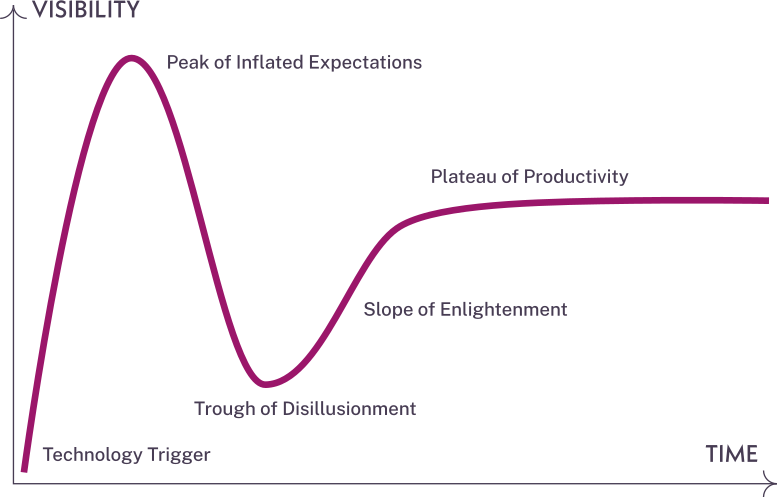
In some ways, it appears the JCA journey will mirror the journey of adoption of technologies such as generative AI. The “Gartner hype cycle” provides a graphical representation of how, after the initial excitement of a technology launch, interest will wane as experiments and implementations take time or fail to deliver.6 The true value is seen once the benefits of a technology are better understood, at which point mainstream adoption will occur. Translating this to the implementation of JCA, it feels we are crossing the peak of inflated expectations and entering the trough of disillusionment. Let’s hope that by ISPOR Europe 2026 or 2027, we have some practical learnings from companies who have navigated JCA and subsequent local HTA across EU member states, to leverage those learnings for the next wave of ‘candidates’ – the orphan medicinal products.
References
If you would like any further information on the summary presented above, please get in touch, or visit our Value & Access page. Grace Lambert (Head of Market Access) and Issy Newell (Head of Rare Diseases) to this article on behalf of Costello Medical. The views/opinions expressed are their own and do not necessarily reflect those of Costello Medical’s clients/affiliated partners.
